On 9 March, I set off from Hattem to Schiphol, where a long journey to Japan awaited me. Roughly twelve hours of flying from Amsterdam to Hong Kong, followed by another four-plus hours from Hong Kong to Kansai Airport in Osaka. It sounds like quite an extensive trip, but with a special cultural visa for Japan valid for a year, a day of travelling is hardly an issue. What I perhaps hadn’t fully realised at the time was that I would be leaving the Netherlands – and the familiar comfort that comes with it – behind for quite a while.
Travelling to the other side of the world nowadays feels almost as easy as taking a train to another city. You take your seat, the doors close, and a few hours later you find yourself on a completely different continent. The man sitting next to me on the plane, coincidentally from Elburg, confirmed that thought. He was off to Hong Kong for ten days with his family. The plane, by the way, was full of families with (very) young children. I didn’t manage to sleep a single moment…
The following morning, the plane landed in Hong Kong with a delay of over half an hour. My transfer time was scheduled to be just 50 minutes, so due to the delay I missed my connecting flight. Not a problem for me, as there was another flight two and a half hours later, for which I was immediately issued a new boarding pass. On top of that, Cathay Pacific gave me a voucher to get something to eat while I waited. A perfectly good deal, if you ask me.
While waiting for my flight in Hong Kong, the now unavoidable reality began to sink in: upon arrival in Osaka, I would be interviewed by a camera crew from Tokyo about my plans in Japan. I therefore hoped to get at least a bit of much-needed sleep so I could appear somewhat fresh on camera. Fortunately, I knew what they wanted to speak to me about. Apparently, it’s not common for a foreigner to come to Japan for a year to learn how to make tatami mats. Issei, the host of my accommodation and son of my tatami teacher, had contacted the TV programme, and there was enough interest to make a feature about it.
Just before boarding my second flight, I received another message from Issei: the camera crew also wanted to accompany us from the airport to the guesthouse in Izumi, to capture where the Dutch tatami apprentice would be staying over the coming months. I had been hoping for a calm and quiet arrival in Izumi, but that clearly wasn’t going to happen.
The flight to Osaka went smoothly, though as I had come to expect in Japan, the immigration process took quite a while. The camera crew had already been waiting for me for some time, as they had assumed I would arrive about three hours earlier at KIX. After finally receiving my residence card and collecting my suitcase, I walked straight towards the three-person crew waiting in the arrivals hall.
“Hello, TV Tokyo, may we interview you?” they asked. “Well, yes of course—that’s what you’re here for, isn’t it?” I thought. The producer immediately spoke to me in Japanese, while an interpreter translated everything into English. A barrage of questions followed, and it felt as though I had to reconfirm the motivation I had submitted for my visa.
It quickly became clear that the interview was meant to appear spontaneous. Issei was somewhere at the airport as well, but had been instructed by the director to ‘hide’ from me so that my arrival and our reunion would look natural on camera. Yoshiki, the director, naturally asked why I had come to Japan, fitting the title of the programme: “Why did you come to Japan?” Of course they already knew the answer, but it had to come across as a surprise. Without anticipating it, I had apparently become something of an actor myself.
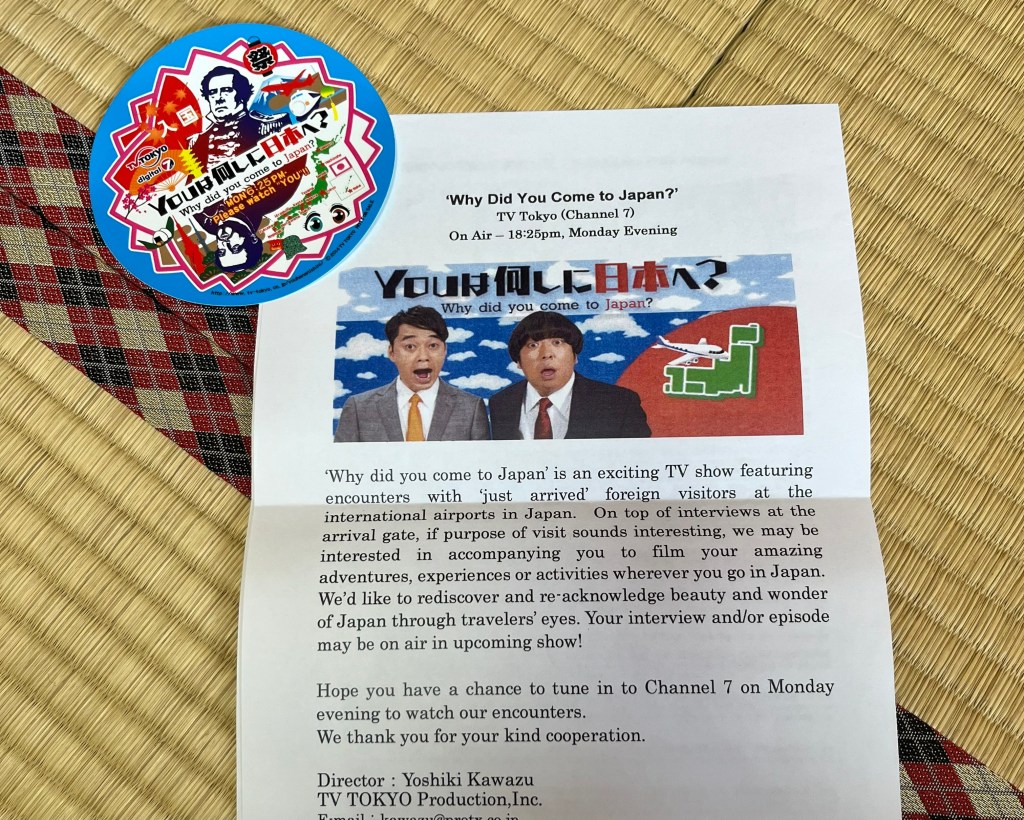
Because of my dazed state from lack of sleep and the long journey, I didn’t always manage to express myself very clearly. I tried to use the few Japanese words I had learned to come across as a more seasoned visitor to Japan, which didn’t quite have the desired effect. “What is it you like about tatami so much?” Yoshiki asked. “I like the use of natural materials, like igusa (いぐさ),” I replied. “And what do you like about that?” came the follow-up. “Well,” I said, “totemo oishii desu”—it’s very tasty. Their reaction: confusion. “Did you eat it?”
After the interview at the airport, the crew still wasn’t finished with us. They accompanied us to the guesthouse in Izumi, as had already been arranged with Issei. I was fitted with a microphone so they could record as much as possible. Upon arrival in Izumi, we met Hiromasa-san, Issei’s father and my sensei for the coming year. The crew filmed everything, which felt slightly uncomfortable, as I couldn’t experience my return to Izumi for a single moment without a camera present. At the same time, it was quite amusing and special to have such a professional crew following me around in a (more or less) unfamiliar country. It felt as though I had my own reality series, if only briefly.
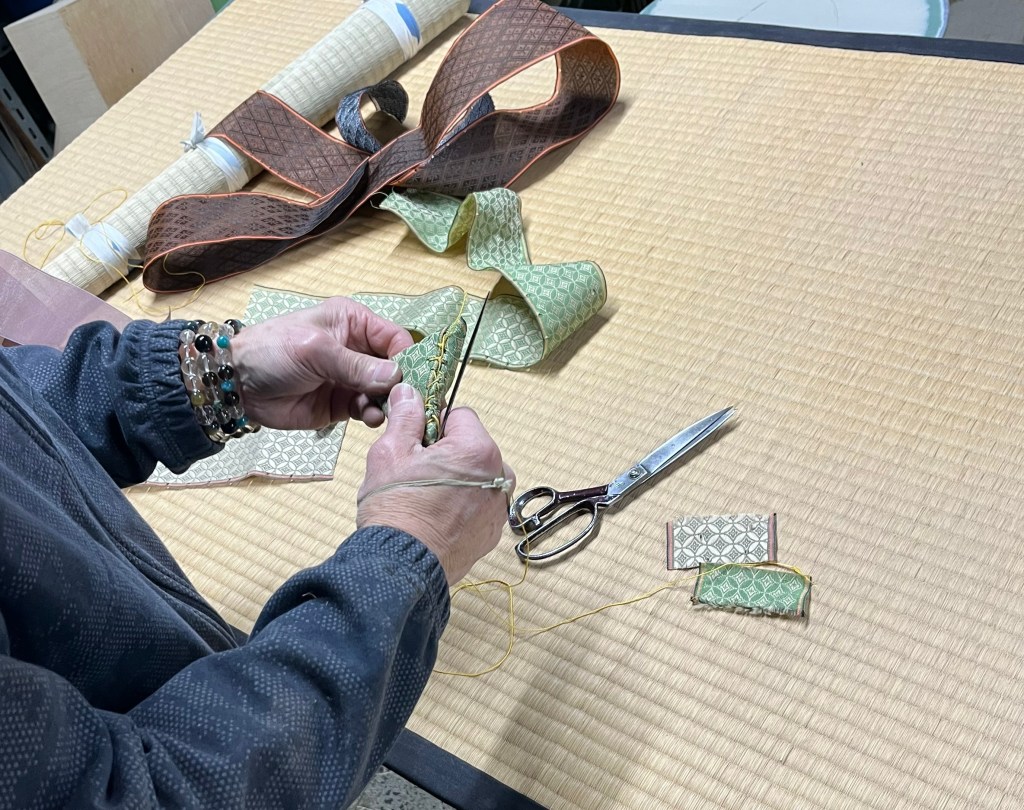
Naturally, they also wanted to film inside the tatami workshop, where Hiromasa made my own teate (てあて), a protective guard for the palm of my hand that I will need during my training. Once the teate was finished, I could (and had to) use it straight away to practise a specific technique involving a long needle that must be pushed through the tatami mat. It was, in fact, my very first real experience with needle and thread, and it didn’t come easily.
It was getting late, and I still hadn’t slept since leaving the Netherlands. Kana (Issei’s wife) and the other Kana (Hiromasa’s wife and Issei’s mother) had prepared hotpot for dinner. I wasn’t particularly hungry, but a warm meal and warm company were very welcome in the chill of March. The film crew joined us once again. While we sat at the table enjoying the food, they stood beside us constantly filming everything. They asked whether I felt completely at home now that I was back in the familiar guesthouse where I had also stayed for an extended period in 2024. “Absolutely! Despite the fact that a three-person TV crew is currently filming me while I eat.” I replied a little jokingly.
It wasn’t until around ten o’clock in the evening that the crew finally began to leave for their hotel. However, they wanted one last shot: me going to bed. At the airport, I had mentioned how much I enjoy sleeping on tatami mats – it feels like lying on soft, finely woven dried grass. Naturally, my sleeping space is a small tatami room with a futon, a foldable mattress placed directly on the floor. To round off the day, the crew needed one final scene: me lying down on my futon and going to sleep on the “grass” beneath me that I had spoken so fondly of.
Fortunately, they got the shot in one take. Not long afterwards, I was finally able to get some much-needed rest after being awake for roughly 32 hours straight. As they say in Japan before going to sleep: oyasumi おやすみ.
 sleeping on grass (草の上で寝る)
Leave a comment