
“Atsui desu yo ne!?” The rainy season has come to an end, and the Japanese summer makes life harder than usual. Before I experienced it myself, I thought it couldn’t be all that bad. But in this hot, humid weather, you really don’t want to do much else besides staying indoors, and certainly not spending too long in the sunlight. Nevertheless, on 4 July, I made the decision to cycle to Makiosan once again on my day off. Shindoi, exhausting! It was the last time I would cycle such a stretch (an hour, uphill) during the Japanese summer.
At Fujitatami, the Swedish volunteer, Emil, had just left. A Catalan lady, Berta, had taken his place. She told me initially that, apart from visiting a Spanish (Catalan) friend living in Tokyo, she didn’t have much reason to come to Japan. Apparently, Japan has become such a popular destination that nowadays people simply go there just because they can. Seeing the film Perfect Days had apparently won her over to make the trip. I hadn’t seen this film yet, but I had read the glowing reviews about it.
After finally watching the film on Netflix, I understood the positive reactions and why it serves—and has served—as good publicity for visiting Japan. It depicts a romantic slowness and tranquility in everyday Japanese reality that is welcome in our rushed, nonsense-filled society. Nevertheless, it is a romanticism of slowing down that seems all the less recognizable from the perspective of the hot summer months. Slowness and tranquility are now a matter of necessity for survival, not of appreciating the moment. At least, that’s how it feels to an unaccustomed foreigner like myself. Still, there are plenty of things to enjoy, provided you don’t mind the continuous sweating.
In the tatami workshop, I am still busy making special tatami shapes. This month, these included an octagon and a pentagon. They are essentially further developed forms of the square shitone, and slightly trickier to make because the angles are not perpendicular. Consequently, this also means it is impossible for the pattern to continue seamlessly around the corners. Furthermore, the math and measurement work require a bit more attention, but the principle remains the same as with square tatami. Once this is done properly, the stitching is merely a meditative formality.
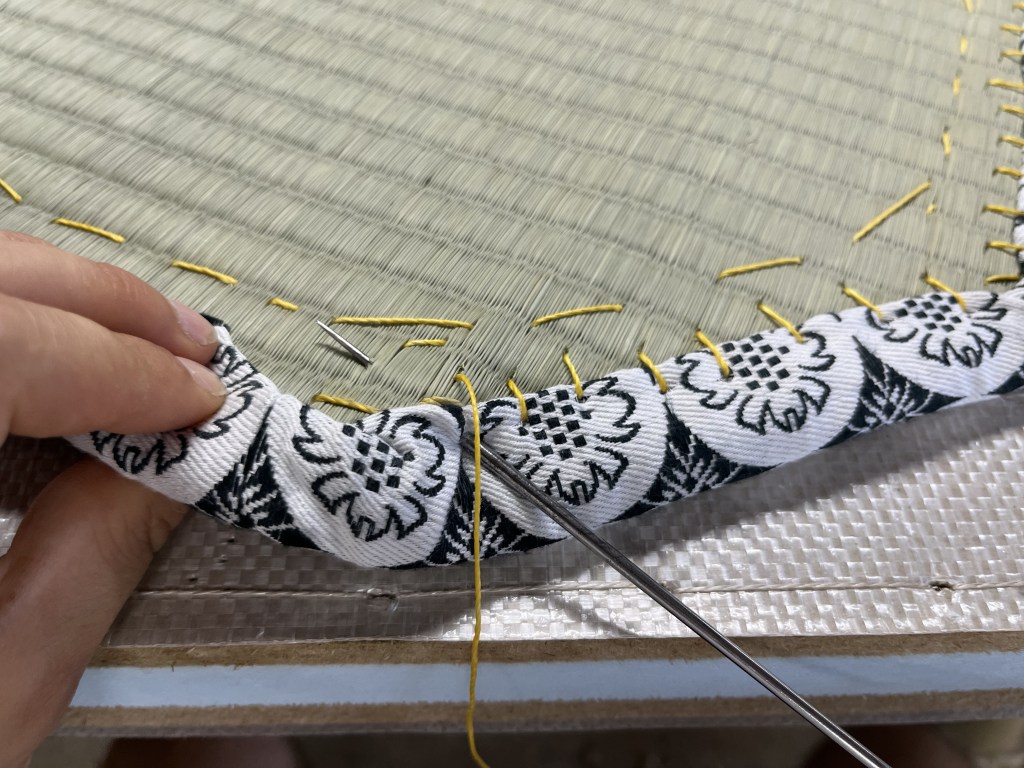
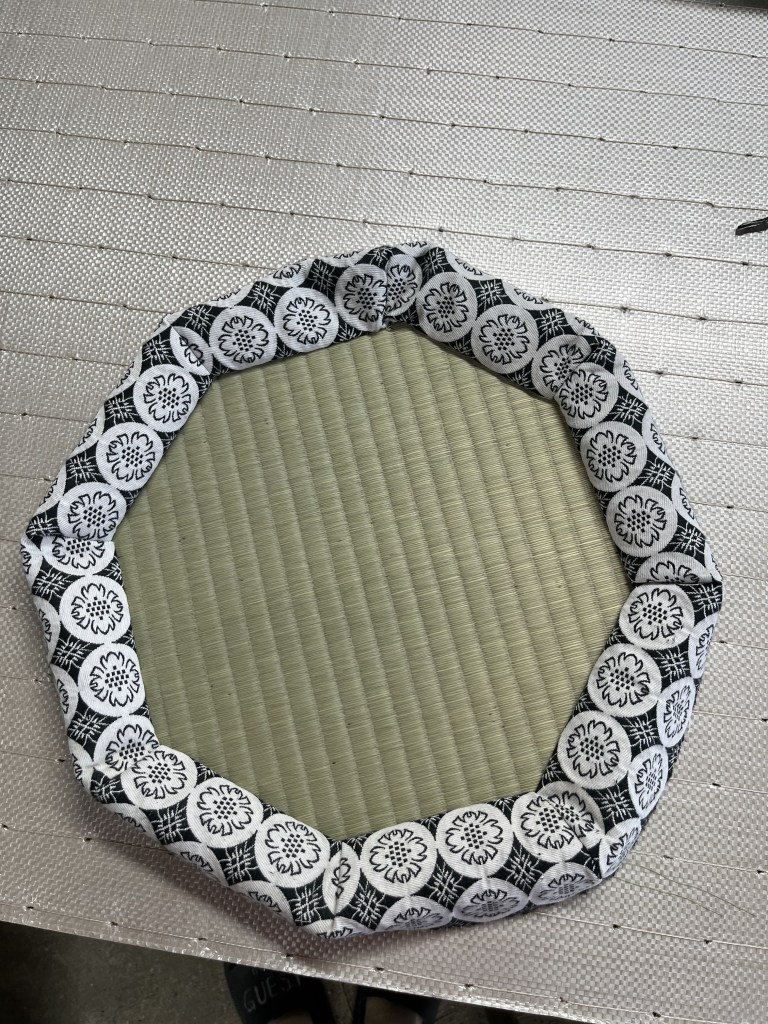
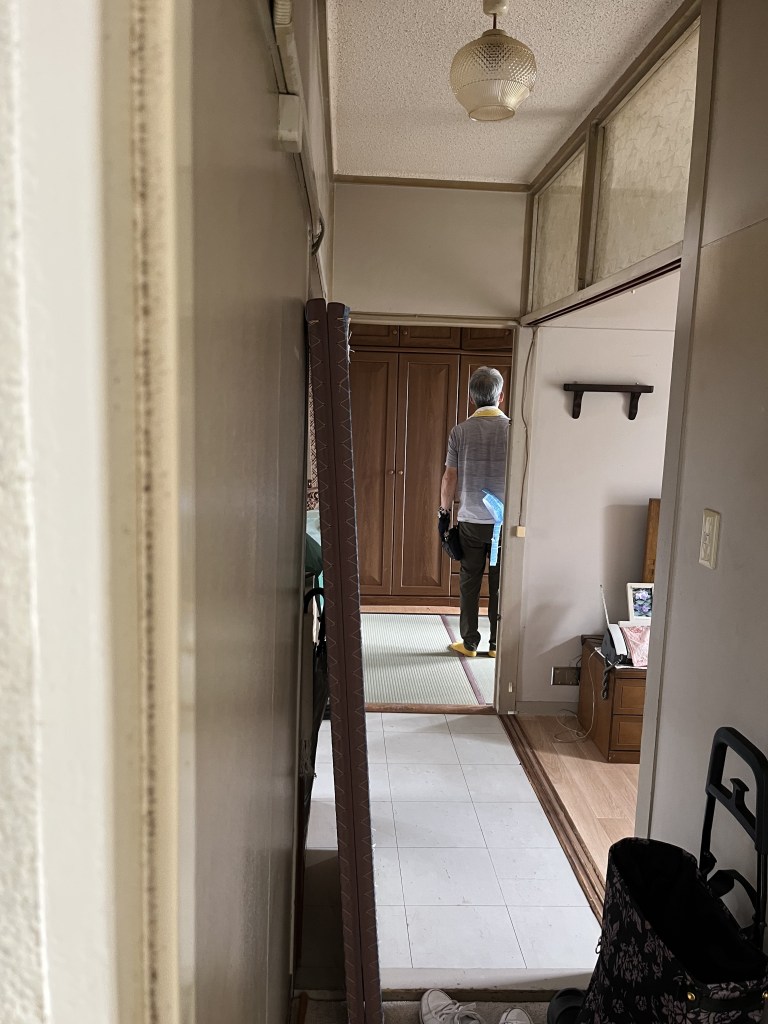
The days go by and slowly become even hotter and more humid. Temperatures rise during the day to 36 to 38 degrees, and in the evening it doesn’t get much cooler than 30. Regularly, Hiromasa still has to deliver tatami mats to social housing flats, sometimes located on the 4th or 5th floor without a lift. Between the two of us, hauling up to 10 tatami mats upstairs is already a heavy task, let alone having to do it on your own. It is at those moments that I feel most useful during my apprenticeship.
Since the period of grey, rainy days was only recent, seeing a clear blue sky with sunshine was still a pleasant sight. To celebrate the summer, we thought it would be a good idea to head to a lovely beach in Wakayama. The four of us set off by car in the morning for Wakayama, which is about an hour’s drive from Izumi. Shortly before arriving, we pulled over at a 7-Eleven, as it is apparently customary to grab a beer for the beach, regardless of the time of day.
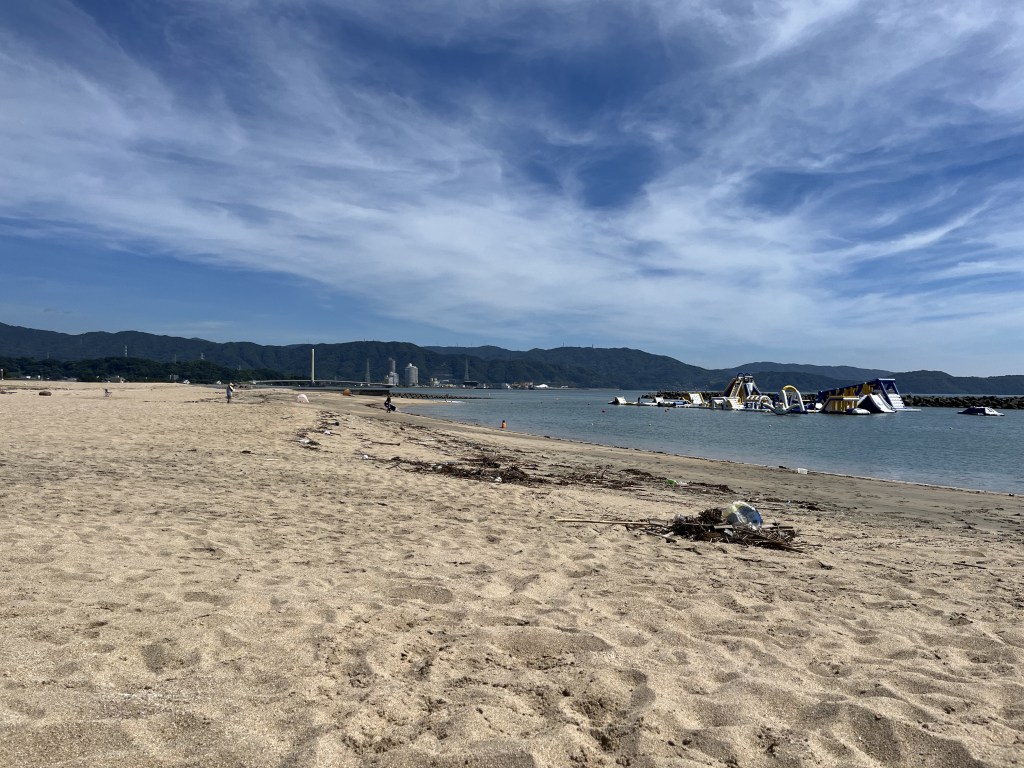
In the morning, it was still bearable on the beach, and especially with a regular dip in the sea, it was quite pleasant. Against our better judgement, however, we stayed on the beach and in the water for too long, completely exposed to the sun. I was severely sunburnt, but Kana was even worse off. Her face remained swollen beyond recognition for a few days.
Following on from the lazy adventure in Wakayama, I attended a concert in Osaka by Shing02. A Japanese rapper who is known for, among other things, the Luv(sic) hexalogy in collaboration with the producer Nujabes, who passed away all too young. Here Shing02 rapped the entire hexalogy accompanied by a British band playing the iconic tracks live.

On 15 July, Hiromasa got another special job regarding a social housing flat. The resident had suffered from a leak, which had damaged tatami mats in her flat. This very small flat was packed with large furniture, so replacing the tatami mats was a huge challenge, especially with the heat and the fact that there was no air conditioning present. Once again, shindoi!
What also causes discomfort and annoyance is the construction of 15 new homes right behind the guesthouse and Hiromasa’s house. Space there is extremely limited, yet 15 new houses are being built next to the rice fields where there was still some breathing room in the increasingly densely built-up suburbs that make up Izumi. “I am opposed to the continuous construction of buildings when the Japanese population is declining.” Something I can certainly agree with as well.
With the persistent heat and humidity, it is still a matter of survival, and deciding to go out at the weekend comes with an obstacle that is hard to overcome. Nevertheless, Berta and I, almost against our better judgement, set off on an adventure to the north of Osaka Pref., namely Minoh and Katsuoji. The waterfall at Minoh is known as a major tourist attraction, and Katsuoji temple, a 1-hour walk from the waterfall, was also said to be worth a visit.
It is a two-hour train ride from Izumi to Minoh, and the closer we got to our destination, the more Spanish tourists we (or rather Berta) noticed. Berta is, as mentioned, Catalan, and holds a strong opinion on the Catalan issue. Whenever Spanish was spoken nearby and overheard, it was amusing to watch her facial expression change.
From the moment we stepped off the last bus to continue on foot towards the waterfall, we were immediately overwhelmed by the heat once again. We had long since accepted the sweating. We had set ourselves two goals, and we were going to achieve them. After strolling along the lovely, winding Minoh River among the deep green trees for an hour, we reached the waterfall. Due to the heat, it wasn’t as crowded as the reviews on Google might lead you to expect, which was a stroke of luck. Nonetheless, it was mostly just taking a quick look at the falling water, snapping a photo, and moving on. Besides, we had certainly earned a beer.
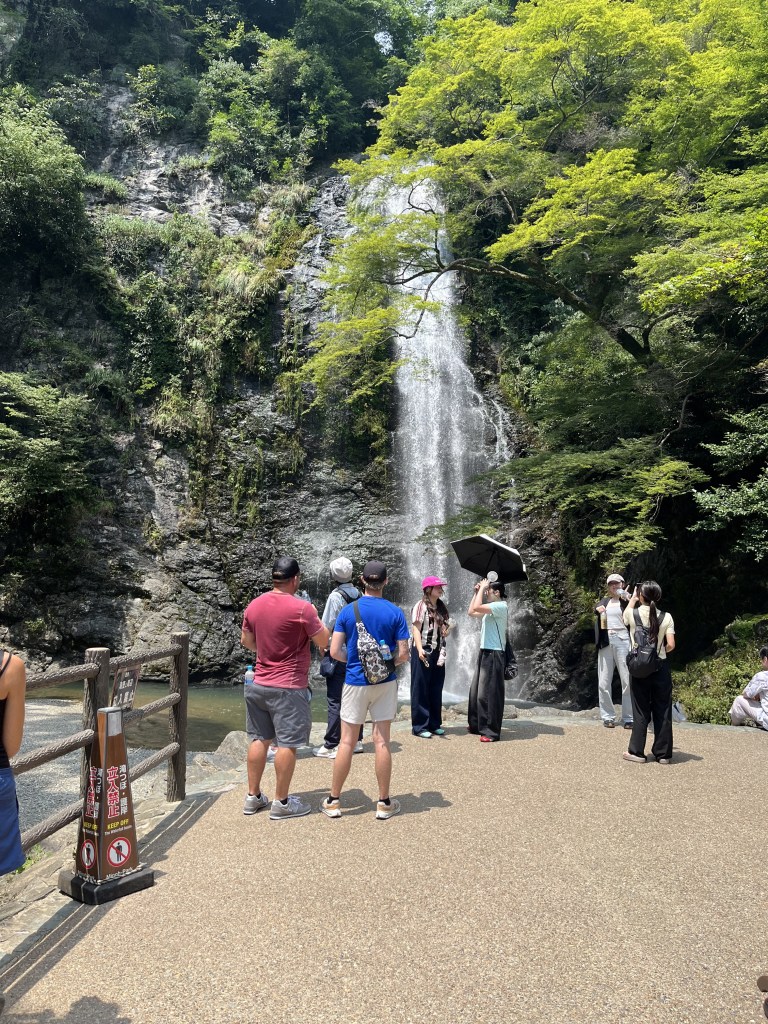
After the beer, we continued our journey on foot towards Katsuoji Temple. Along the road, it’s about a 50-minute walk, but there were also supposed to be hiking trails going a bit more through nature. However, the first entrance to the hiking trail was blocked (or guarded) by a large troop of monkeys with whom we didn’t want to pick a fight. Therefore, we decided to just follow the main road to the temple instead.
Upon arrival at the temple, it seemed as though we were the only two who had walked there. We looked (and probably smelled) as if we had been walking for a few days straight, and initially, I felt underdressed among the other tourists who were stepping off the buses in flawless outfits. It was also the kind of place I probably never would have visited, had Berta not had it high on her list. I’m not really into those mega-popular tourist attractions where masses of people queue to look at the exact same famous view and take a picture of it, so I hadn’t expected much from this visit beforehand.
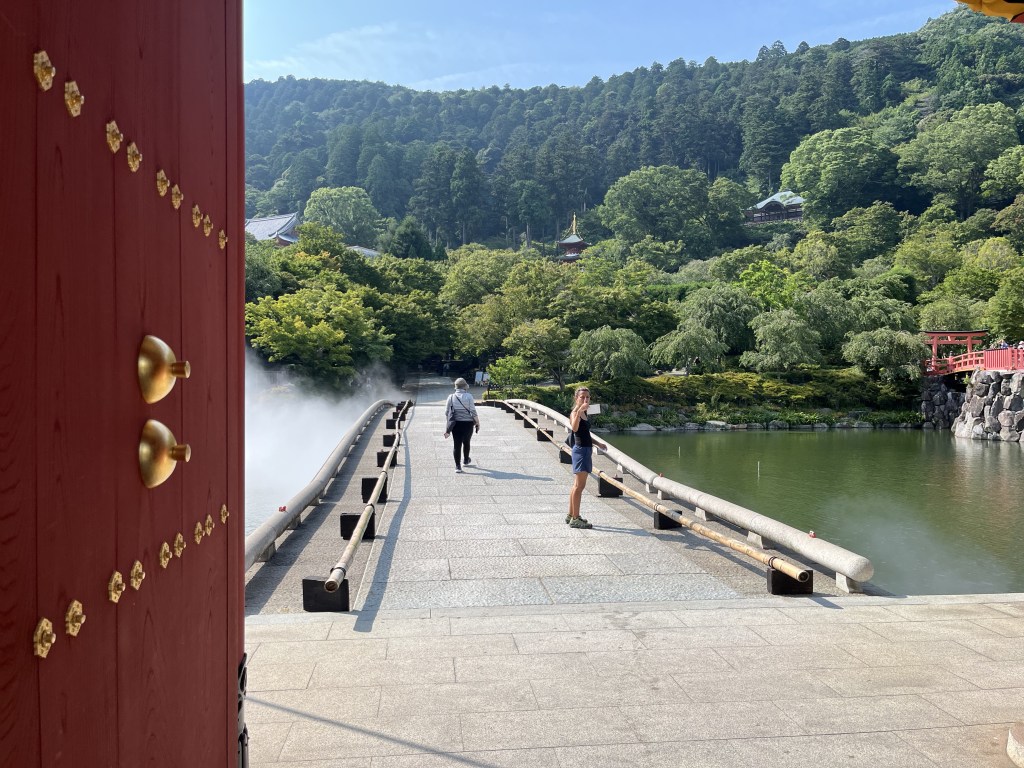
However, immediately upon entering the large, aesthetic temple garden, I was glad to have come after all. The entrance through the gate led to a bridge over water where an artificial mist enchanted the atmosphere. Despite it being relatively quiet at this famous spot, the proportion of Spanish tourists was quite high, which perhaps somewhat disenchanted the magical atmosphere for Berta.
To make matters worse, the Spanish football team would also go on to become world champions the following day. But one consolation is that several key Catalan footballers did help lead the team to victory against Argentina.


Leave a Reply