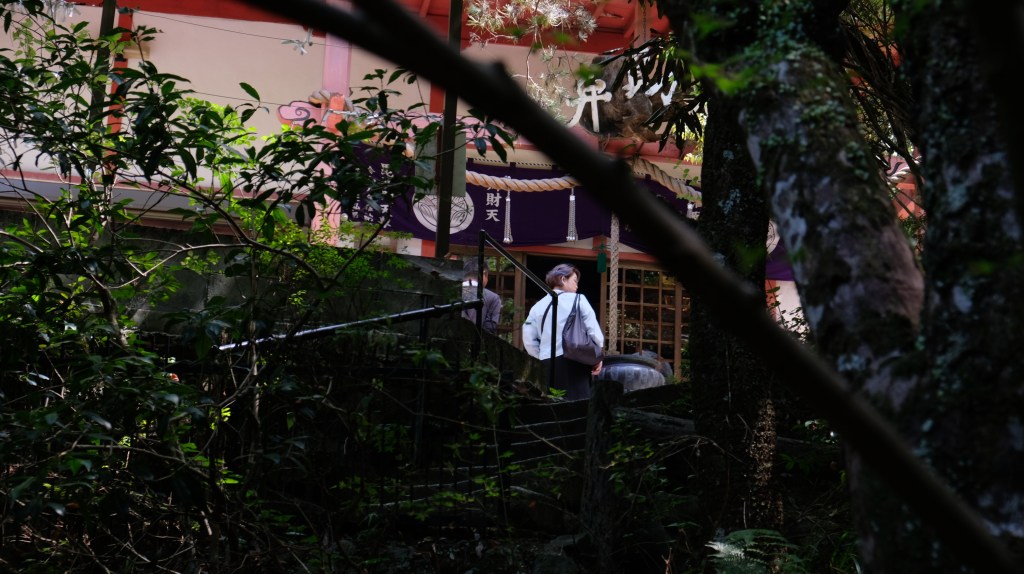
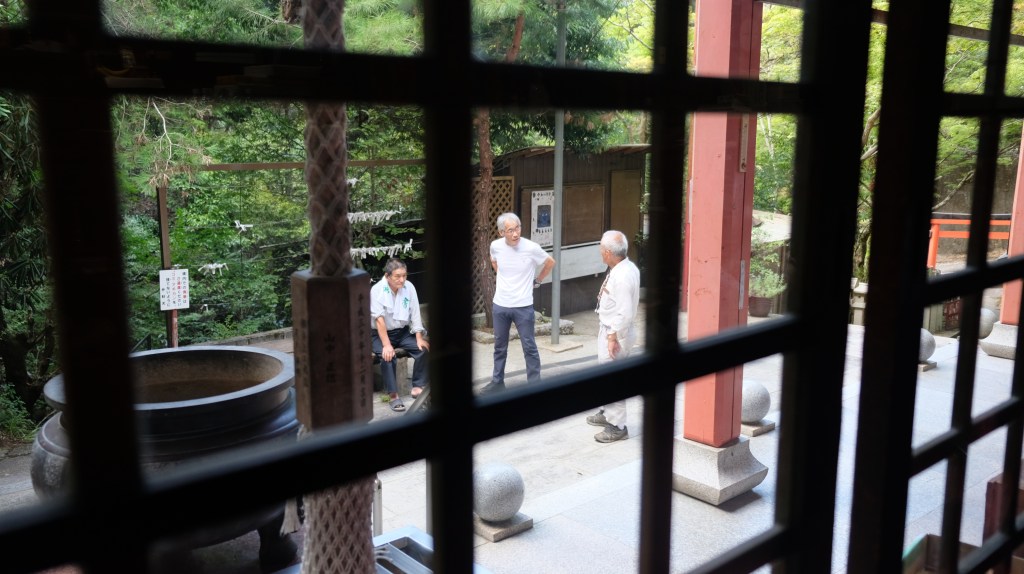
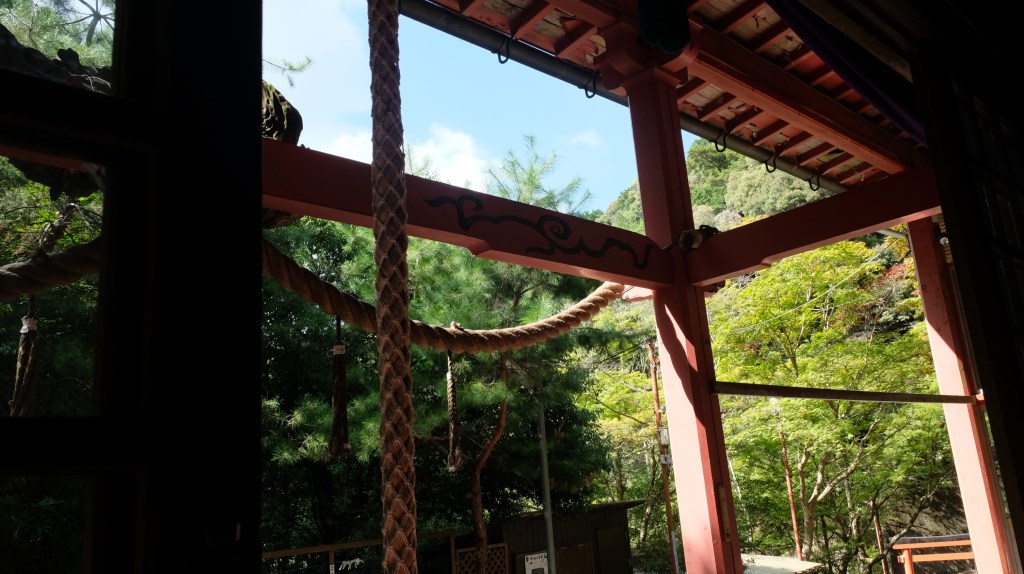
On 1 September, Hiromasa and his wife Kana took me to the shrine at Makiosan. A special Shinto gathering called ‘Narigama’ is held there. Whether it is an unknown, forgotten, or uninteresting event for most people, I do not know, but there were only about fifteen others present. That very same day, I put this experience into words, as it felt rather special and so that I would not forget the details and the course of events during the ritual. Here are my notes:
Today a Shinto ritual at the small shrine next to the waterfall at Makiosan. With Hiromasa-san and Kana-san. A mysterious affair. There were about 15 others, mainly middle-aged or older women. There was also a very old man and two other men. A fourth young man came in just as the ritual had started.
There was a large vat with water in it above smouldering and flaming coals. The young monk/ritual leader gave us a pinch of salt to ritually cleanse ourselves, both in our mouth and on our shoulders and body. Mantras were chanted by the monk and every few lines, all of us characteristically clapped twice. That repeated a few times. We were summoned one by one to the centre and were energetically (?) cleaned or ritually purified there by the monk with a peculiar staff with bells.
The mantras started again, but even more intensely. Accompanied by the jingling staff in three-quarter time, which was very much like a waltz. It began to become hypnotic, and meditative at the same time. Most participants joined in reciting the mantras and the energy was noticeably building up. At a certain moment, I began to hear a loud, low, deep and continuous humming, as if it were a special alarm signal. I couldn’t see where the sound was coming from.
The energy reached a peak. Japanese voices, mainly female, producing mantras very rhythmically to the accompaniment of the mysterious instrument that was the jingling staff. There was a deep focus and great collective attention in the moment. And there was a lot of noise. I noticed that when I moved my head slightly, the humming deep vibration could become louder or softer. It made me think of the sound waves demonstrated in physics class at secondary school. The humming here in the shrine just kept going, as did the rhythm of the mantras and the clattering of the instrument. I had intended to pay attention to when I would hear the loud humming stop.
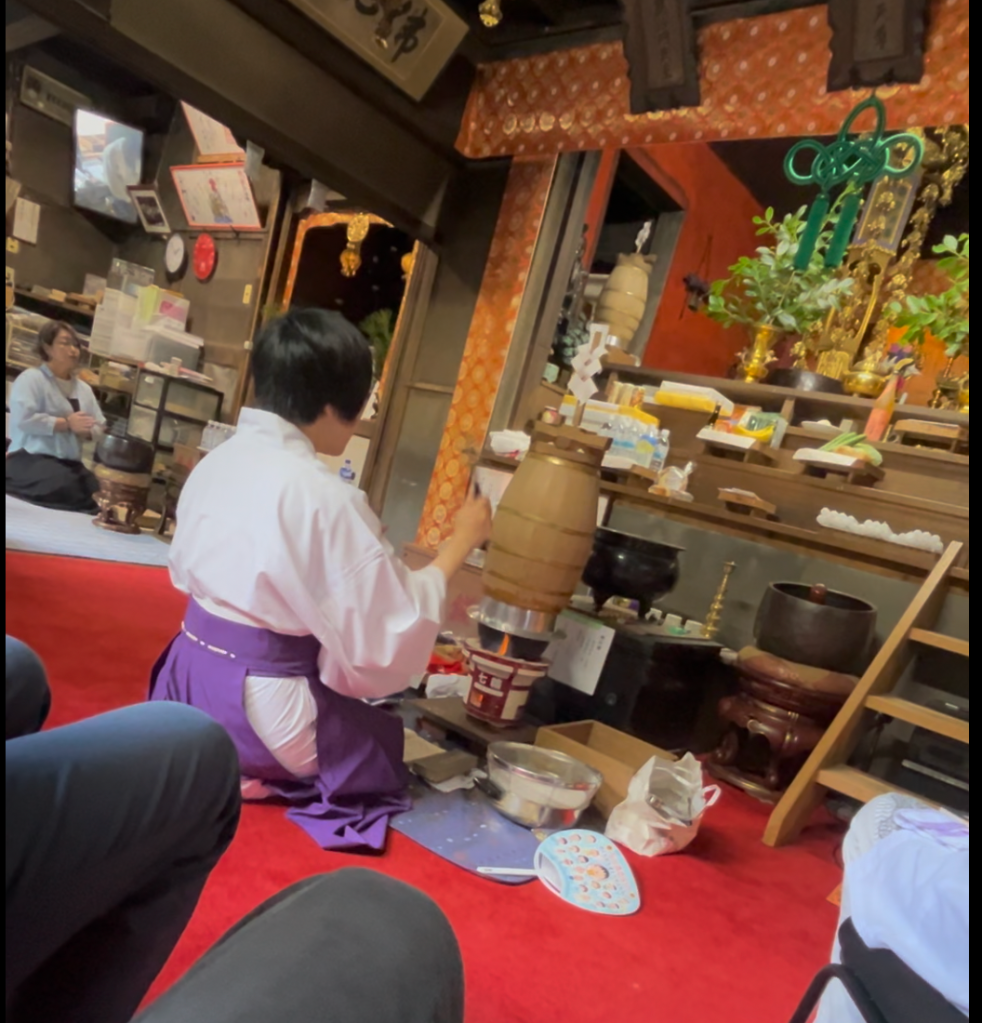
Meanwhile, I had found out that the deep, loud, thrumming hum came from the steaming vat. Just like boiling water leaking from the cracks at the top. I looked around during the ritual and saw those present in deep concentration, eyes closed, chanting mantras. The energy was mind-altering, as if I had ended up in a sudden trip.
After some time, however, the humming had ceased, but I did not notice when it ended. I really was lost in the moment and had become part of the collective focus. The explosive energy in the room was subsiding again and was making way for calmness.
I have already lost track of the chronology of events. But the monk made a few more very special hand gestures towards the vat, removed the lid, decisively put rice into it, and had all participants put some rice into the vat one by one as well.
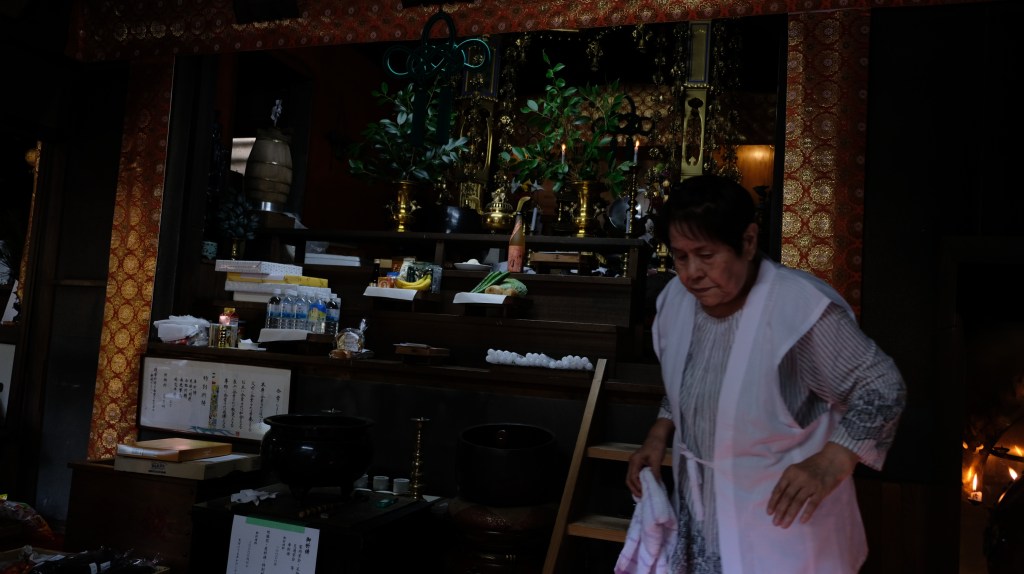
Afterwards, it turned out that this was a ritual to gain insight into the near future: is it positive or negative? So apparently, the vat does not always make a sound during this ritual, and often not this loud. The louder the sound, the more favourable the kami would be to us. Everyone except me knew this of course, so after the ritual the atmosphere was extremely relaxed and cheerful. After all, we had just heard a very loud, thrumming sound.
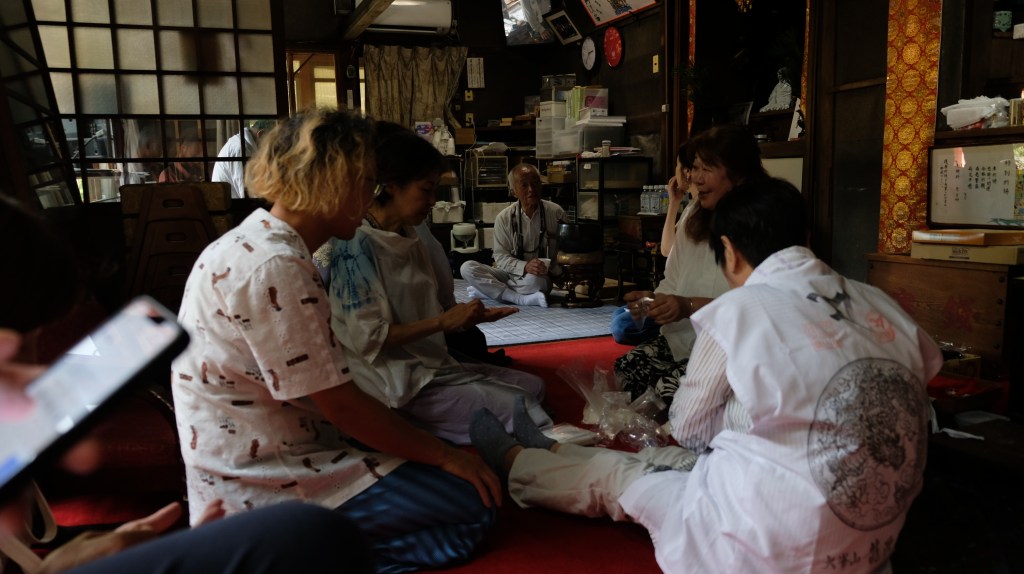
We had also been recognised by one of the older gentlemen present, and the young monk also made a remark during her address about the TV Tokyo broadcast. The man (Kita-san) turned out to be a farmer from near Koyasan, and filled with wonder he knelt down in front of us, giving a monologue in Japanese about how wonderful (subarashi) he found it that he encountered us, as a ‘famous’ tatami duo, right here. He said “Subarashi” dozens of times, and I just nodded along, repeatedly saying “arigatō” to him. In that position in front of us, he was accompanied by a jovial woman who stayed somewhat quieter but was just as present, as every time my gaze turned to her, it was met with a joyful, wide, open smile showing her full set of teeth while she endearingly tilted her head and slightly raised her shoulders, almost as if she were fulfilling the role of a hired cute girlfriend for me.
Upon leaving for home, the half-cooked rice was distributed among those present, as well as some vegetables, pieces of mochi, and small cardboard cartons of sake with a straw. I drank that sake that very evening while cooking, using the attached straw. I just already knew after having almost survived the summer: September, autumn, and the rest of the year will be beautiful and positive. The kami told us so themselves.


Leave a Reply